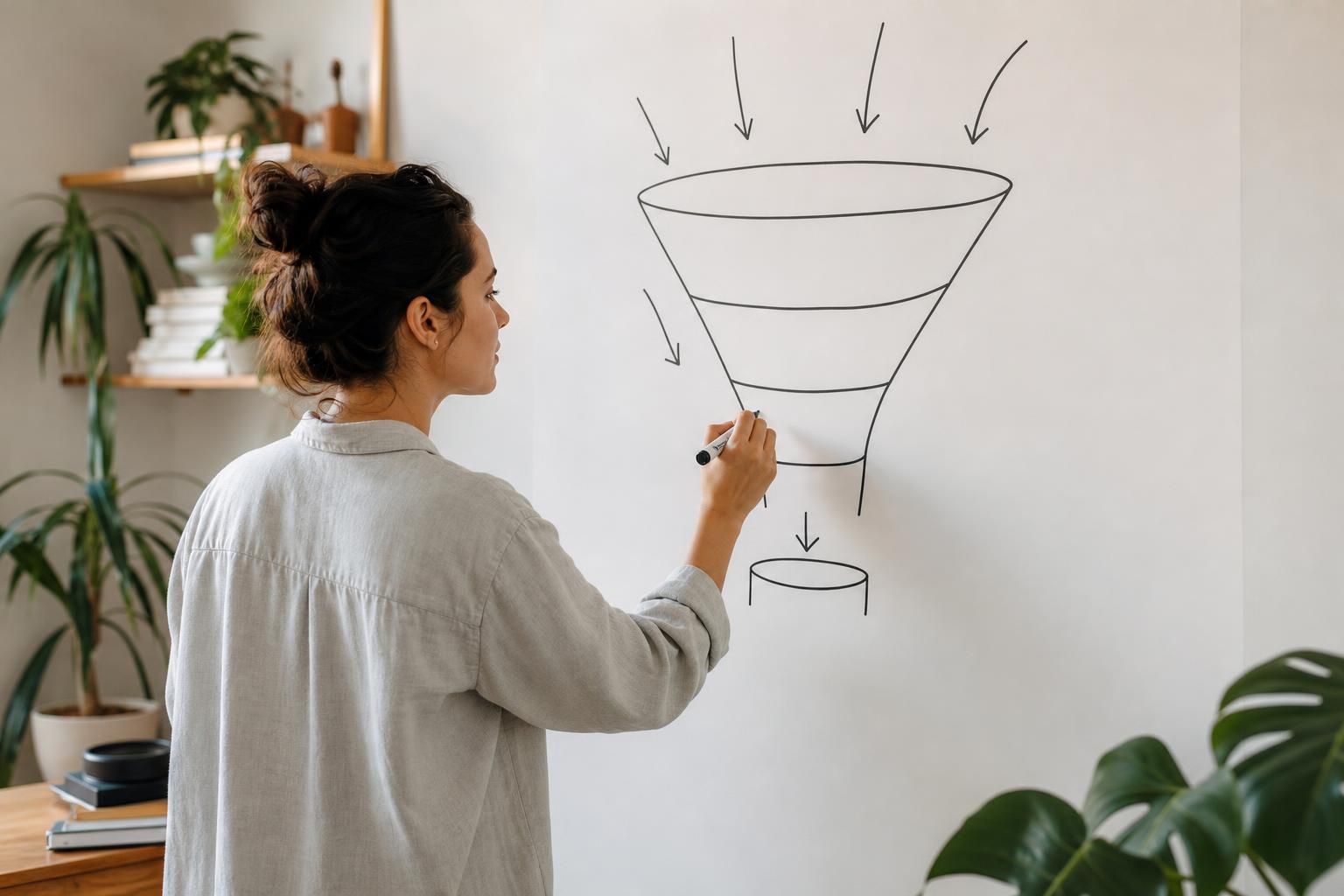
A funnel is the path a stranger takes from "never heard of you" to "bought something" (or booked a call, or joined a list). That's all it is. The software, diagrams and jargon are just ways to build and measure that path. This page covers the basics, what to skip, and where to go next.
What a funnel is, and what it isn't
A funnel is a sequence of steps with one goal. Someone clicks an ad or finds a post, lands on a page, takes an action, and gets a follow-up. Each step should lead naturally to the next.
A funnel is not a magic machine. It can't fix an offer nobody wants, and it can't create demand from nothing. It makes a working offer easier to buy and easier to measure. If the offer is weak, a funnel will just show you that faster. No tool or template can promise you results, and you should be wary of any that does.
The basic parts of every funnel
Whatever you sell, the pieces are about the same:
- Traffic source: where people come from, such as search, social, email, paid ads, referrals or a partner's audience.
- Entry page: usually a landing page, meaning a standalone page with one purpose and few distractions.
- Offer: what you're asking for in exchange for attention. It might be a free guide, a trial, a low-cost product or a consultation.
- Conversion step: the form, checkout or booking page where the action happens.
- Follow-up: usually email, sometimes text or retargeting ads, for people who didn't act right away.
- Tracking: a way to see how many people reach each step and where they leave.
If you can name each of these for your business, you have a funnel plan. If you can't name the offer, stop there and fix that first.
Funnel stages, in plain terms
You'll hear "top, middle and bottom of funnel" constantly. It's shorthand for how ready someone is to buy:
- Top: they have a problem but don't know you. Content, ads and free resources work here.
- Middle: they know you exist and are weighing options. Case studies, comparisons, email sequences and demos help.
- Bottom: they're close to deciding. They need a clear offer, a simple checkout and answers to their last objections.
The most common mistake is pitching bottom-of-funnel offers to top-of-funnel audiences, such as asking a cold visitor to buy a big package. For the full breakdown, read Funnel Stages Explained: Top, Middle and Bottom of Funnel. If you're confused about the terms themselves, What is the difference between a sales funnel and a marketing funnel? answers it quickly.
Choosing a funnel type
Don't invent a structure from scratch. Most funnels are variations on a few proven shapes. Here's a rough guide:
| Funnel type | Good fit when | Common trap |
|---|---|---|
| Lead generation | You sell services, high-consideration products or anything that needs nurturing | Collecting emails and never following up |
| Webinar | Your product needs explaining or trust-building | Underestimating the work of the presentation itself |
| Tripwire (low-cost first purchase) | You want to turn subscribers into buyers early | A cheap offer unrelated to what you sell next |
| Product launch | You have an audience and a time-limited release | Launching to an audience you haven't built yet |
| Direct sales page | The product is simple and the buyer already understands the need | Skipping any follow-up for people who hesitate |
Each type has examples and trade-offs in Sales Funnel Types with Real Examples: Lead Gen, Webinar, Tripwire, Launch and More.
How to build your first funnel
- Pick one audience and one goal. "Small bakery owners book a demo" is a goal. "Everyone buys everything" is not.
- Write the offer in one sentence. Say what they get, and what problem it solves.
- Build the shortest path. One landing page, one action and one thank-you page is enough to start.
- Add a short follow-up. Three to five emails that help first and ask second is a reasonable starting point.
- Test it yourself. Click through on your phone, submit the form, and check that confirmation emails arrive and tracking fires.
- Send a small amount of traffic. Watch where people drop off before you spend real money.
- Change one thing at a time. Otherwise you won't know what made the difference.
If you'd rather follow a worked example, Funnel Setup Tutorials & Use Cases walks through setups by situation.
What to skip (at least at first)
- Complex multi-branch funnels. They look impressive in diagrams but are hard to debug. Get one simple path converting first.
- Upsell chains before you have a core offer. Extra steps can't rescue a main offer that isn't working.
- Heavy design work. A clear headline, honest copy and a working button usually beat a beautiful page with a vague message.
- Copying someone else's funnel wholesale. Their audience, price and trust level aren't yours.
- Buying five tools before you've launched. Complexity in your stack is a cost, too.
Choosing your tools
You have three broad routes, and none is right for everyone:
- Dedicated funnel software bundles pages, forms, checkout, email and tracking in one place. That means fewer pieces to connect, though you're committing to one vendor's way of working. Funnel Foundry is built for this approach, and the platform features page shows what's included.
- WordPress plus plugins can work well if you already have a site and are comfortable maintaining it. See Can You Build a Funnel with WordPress? Plugins vs Dedicated Funnel Software for the trade-offs.
- AI-assisted builders can draft pages, copy and email sequences quickly. Treat the output as a first draft you'll need to edit and check. Best AI Funnel Builders: Tools That Generate Pages, Copy and Email Sequences covers the options.
When you're comparing specific products, look at what you actually need: page building, payments, email, automation, integrations and support. Then check costs. Funnel Software Pricing & Free Options explains how pricing typically works, and Funnel Software Reviews & Comparisons is the place to line tools up side by side. Plans and features change, so always confirm current details on each vendor's official site, including ours.
Measuring whether it works
Track a few numbers: how many people visit each step, how many move to the next, and how many complete the goal. The step with the biggest drop is usually where to focus. Be careful with "average conversion rate" figures, since they vary widely by industry, traffic source and offer price. Use them as rough context, not as a verdict on your funnel. Funnel Conversion Rates: Benchmarks and How to Fix Drop-Offs goes deeper on reading your numbers and fixing leaks.
Guides and answers to read next
Start with whichever matches where you're stuck:
Understand the fundamentals
- Funnel Stages Explained: Top, Middle and Bottom of Funnel
- What is the difference between a sales funnel and a marketing funnel?
- Sales Funnel Types with Real Examples: Lead Gen, Webinar, Tripwire, Launch and More
Build and improve
Choose your tools
- Funnel Software Reviews & Comparisons
- Funnel Software Pricing & Free Options
- All-in-One Platform Features
- Can You Build a Funnel with WordPress? Plugins vs Dedicated Funnel Software
- Best AI Funnel Builders: Tools That Generate Pages, Copy and Email Sequences
If you only do one thing after reading this, write your offer in one sentence and sketch the shortest path to it. That's most of a funnel.
In this section
A funnel is a simple idea: people arrive knowing little about you, and some of them move step by step toward…
Read GuideSales Funnel Types with Real Examples: Lead Gen, Webinar, Tripwire, Launch and MoreA sales funnel is the path someone takes from first noticing you to buying. Most funnel "types" are just diff…
Read GuideFunnel Conversion Rates: Benchmarks and How to Fix Drop-OffsFunnel conversion rates are the most searched and least useful numbers in marketing. Someone says "a good opt…
Read GuideCan You Build a Funnel with WordPress? Plugins vs Dedicated Funnel SoftwareYes, you can build a funnel with WordPress. Plenty of people do. The better question is whether you should, a…
Read GuideBest AI Funnel Builders: Tools That Generate Pages, Copy and Email SequencesAn AI funnel builder is software that drafts parts of your funnel for you: the landing pages, the sales copy,…
Read AnswerWhat is the difference between a sales funnel and a marketing funnel?A marketing funnel covers the whole path from a stranger first hearing about you to becoming a customer, and…
Read